
Thought leadership disrupted:
a manifesto for change
Thought leadership as we know it needs to evolve. Here’s our view
on how to fix it.
From strategic differentiator to table stakes
For most of its history, thought leadership was something of a minority sport, played by a handful of strategy consultants and professional services firms. There were good reasons why only a small number of companies participated. The barriers to entry were high. Producers needed specialist expertise and resources to invest in research, editorial, design and distribution. They also needed a point of view, which often came from busy senior leaders who felt they had better things to do than pen white papers.
This exclusivity allowed firms to build deep competitive moats around themselves. Thought leadership provided an opportunity to develop and maintain a strong, distinctive positioning built upon expertise, authority and trust. These companies were seen as genuine experts, and this was an essential part of how they won business and gained credibility.
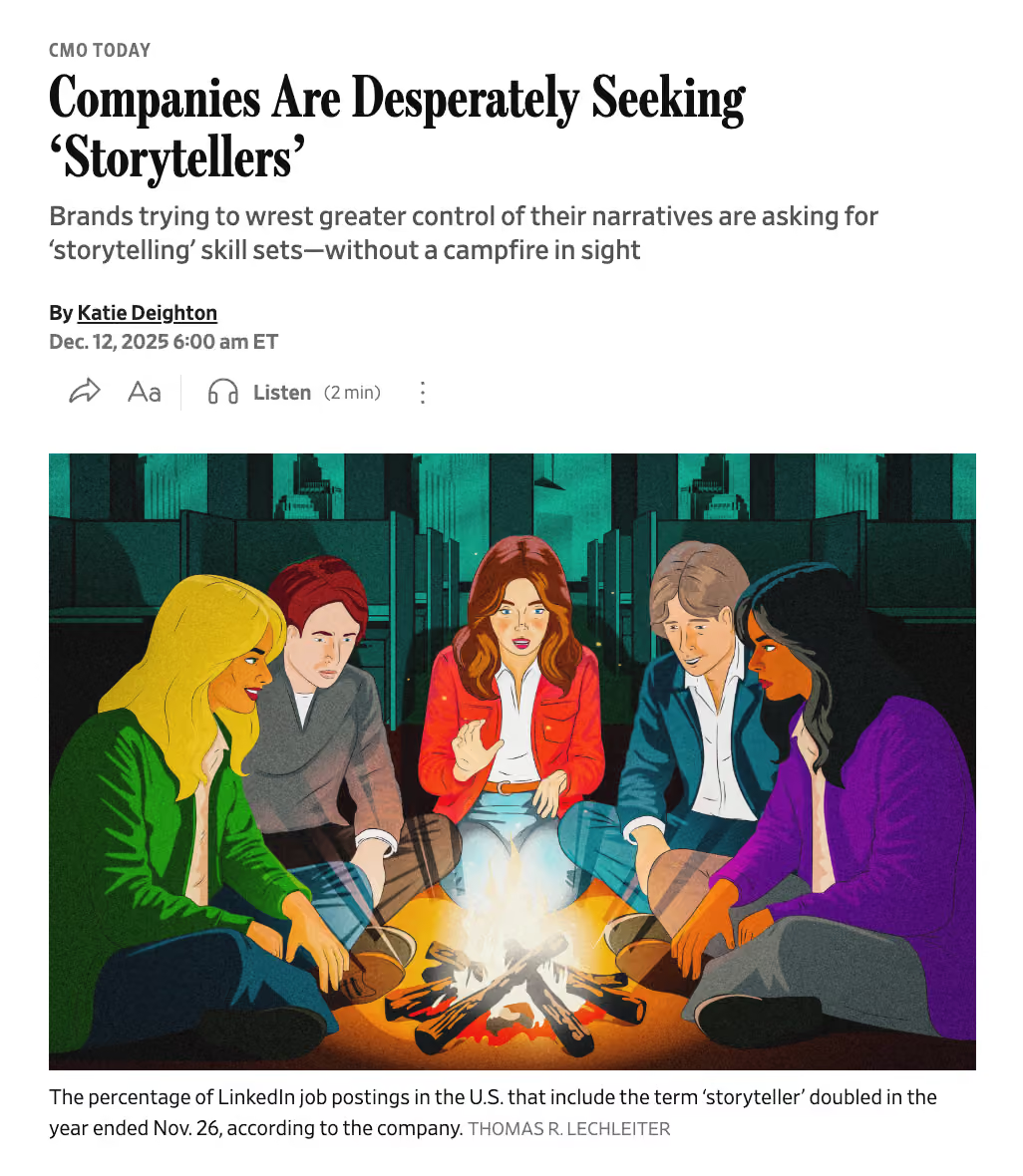
Today, thought leadership is no longer an elite pursuit. It is something that pretty much every B2B company sees as core to their marketing and communications. Its ubiquity has been a boon for agencies and publishers looking to jump on the thought leadership bandwagon, but it has made the competitive advantage to be gained from producing thought leadership much more elusive. Simply producing this kind of content is now table stakes. And the companies that truly stand out with their thought leadership content are rare.
Rising investment and volume
Back in 2021, a study from Edelman and LinkedIn found that 66% of B2B decision-makers had observed a "huge increase" in thought leadership content. At the time, this was partly pandemic-driven as marketers shifted emphasis from events to online. But this was not a temporary blip. If anything, the juggernaut has continued to accelerate.
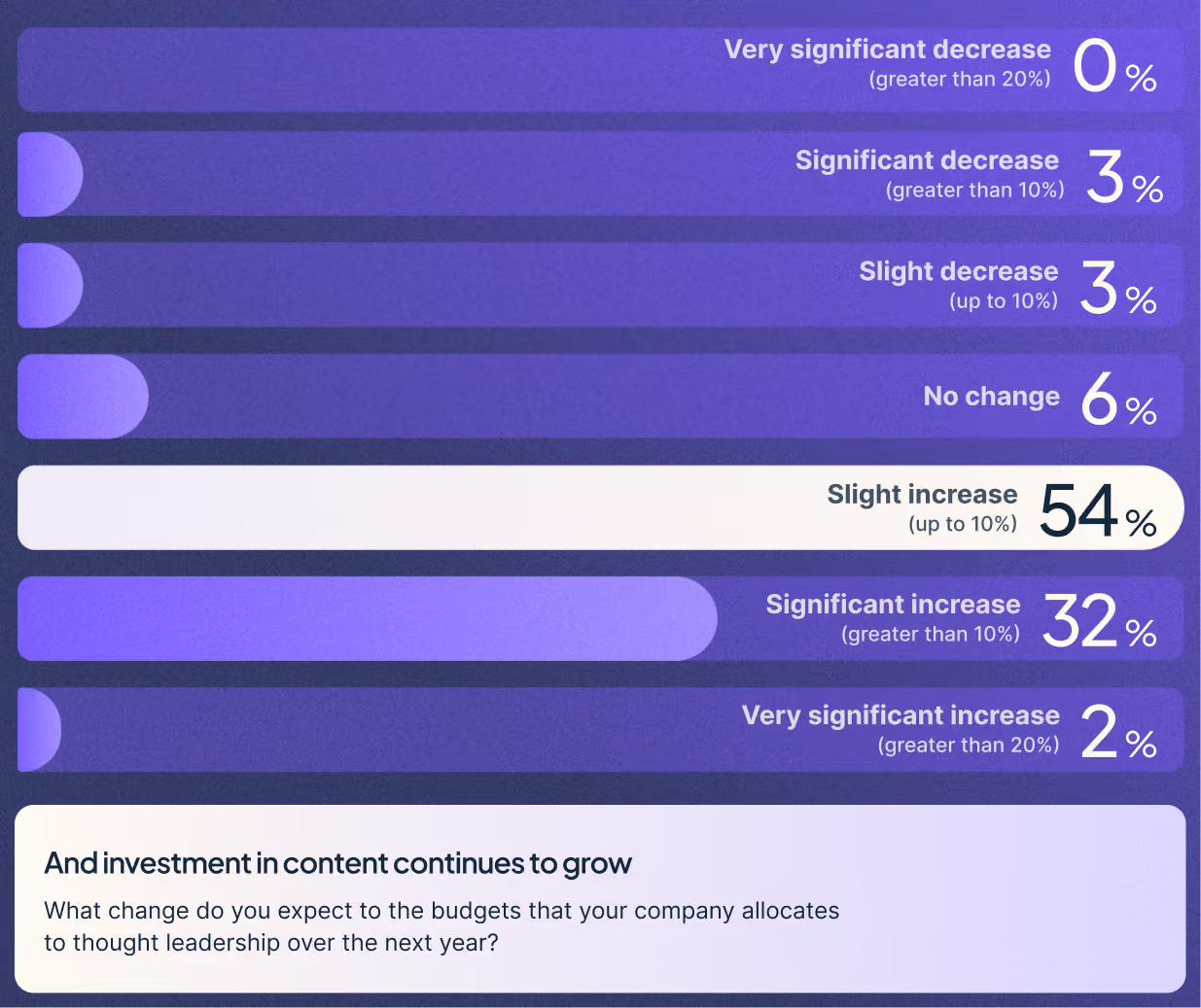
Research from Exhibit B Partners found that one quarter of B2B marketing leaders say that they produce more than 100 pieces of content every year, or almost two a week. Investment in this area of marketing is growing, which points to even more content in future. In our survey, 88% of respondents say that budgets for thought leadership will grow next year and one-third say they will grow by more than 10%.
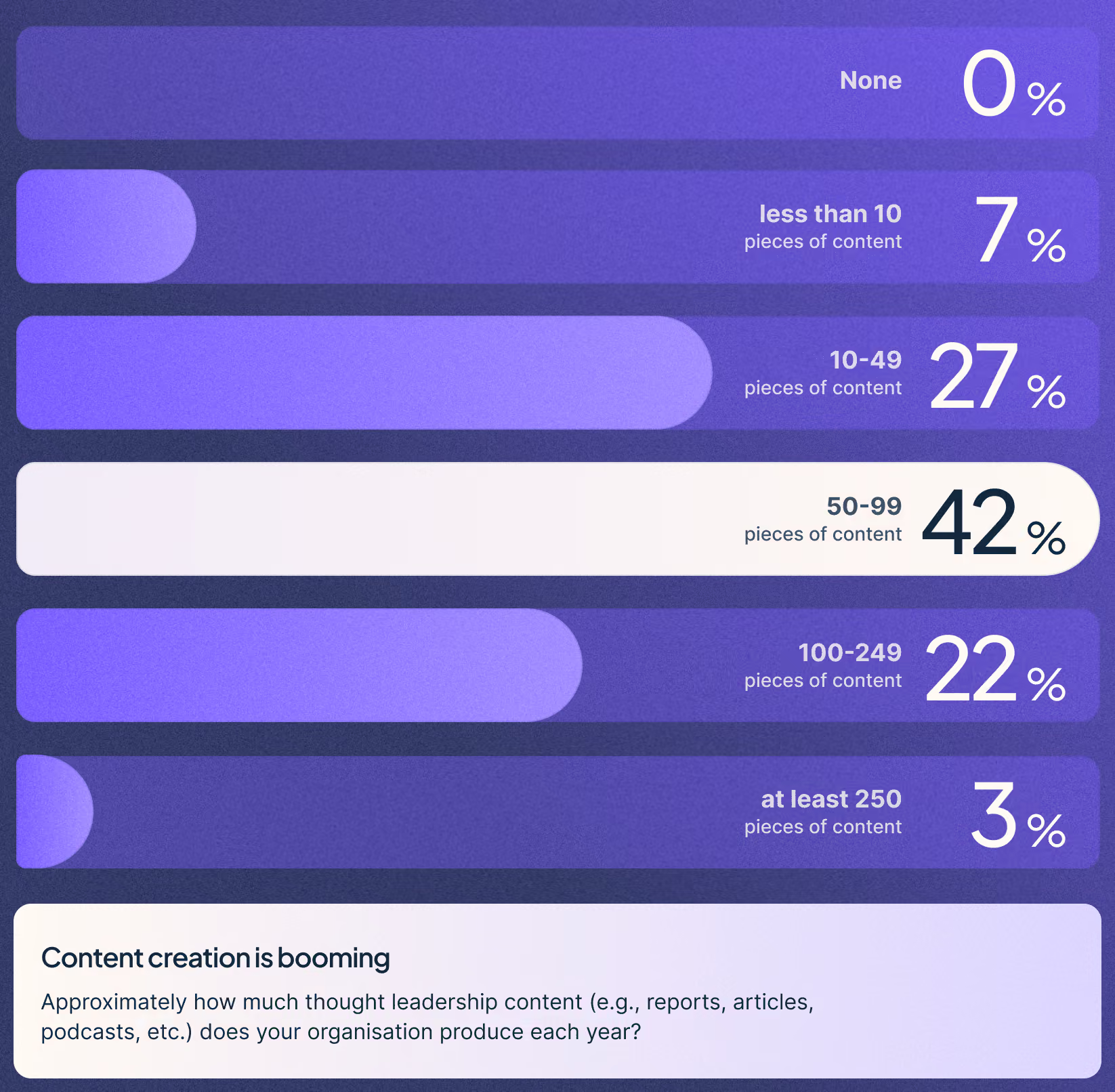
AI has almost certainly made this situation worse. Even before LLMs entered mainstream usage with the advent of ChatGPT in late 2022, the content landscape was crowded. Today, the barriers to entry for creating content are zero, and this means that companies can vastly increase their output with a simple prompt, making it even easier to bombard audiences with messages and research.
One much-quoted statistic from the SEO firm Graphite says that, in 2025, more than half of all content online was AI-generated, although a lot of this output was simple “how-to” guides and product reviews, rather than high-quality, persuasive content.
Of course, just because there is more quantity, it does not follow that quality has improved. According to Hubspot’s 2026 State of Marketing report, 71% say AI helps them create significantly more content, but 52% think that because AI makes content so easy to create, it is less effective overall.
The result is that audiences are now drowning in a sea of mediocre, samey, me-too output. This has had the unfortunate effect of devaluing the concept of thought leadership as a whole, diminishing trust and making it harder for audiences to spot quality insight.
A rapidly growing profession
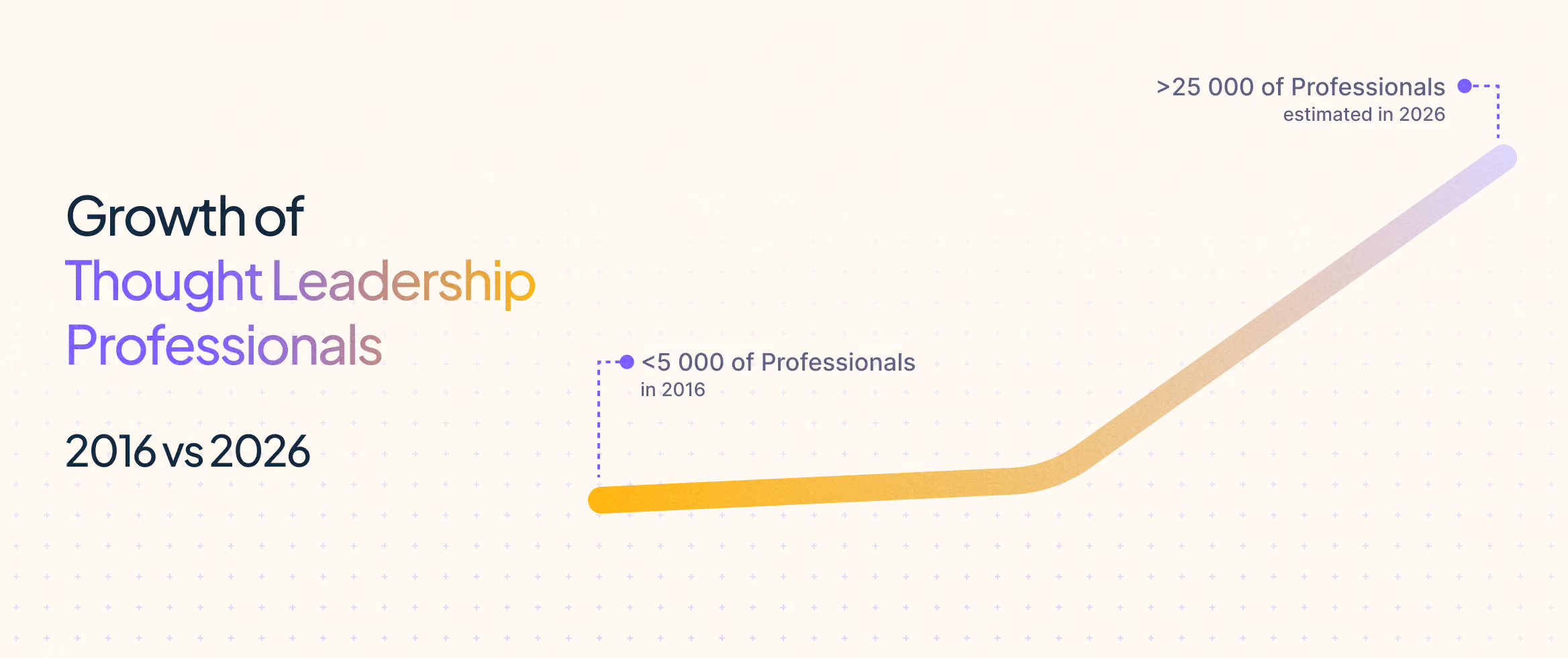
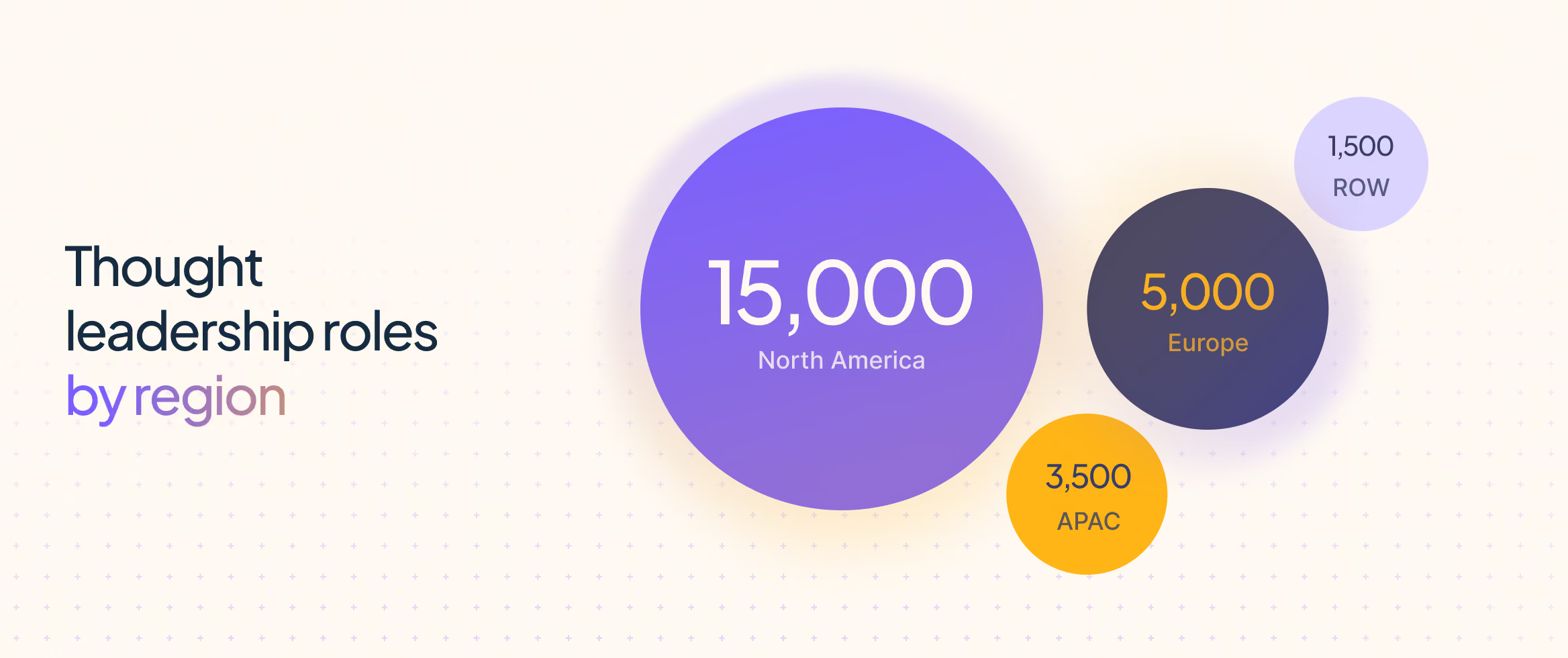
Along with the growth in the volume of content, in-house thought leadership teams have been expanding over the past decade and the pace of growth has accelerated since 2021.

Our own worst enemy:
Why change is needed
The volume of content being produced is a problem but it is not the only one. Thought leadership is often its own worst enemy. There is, unfortunately, a laziness behind a lot of the output that is meant to pass as thought leadership. In our opinion, there are four major problems that need to be addressed.
Problem 1: A tired model
It is almost impossible to stand out if your content is largely following the same formula. The “survey plus long-form report” formula remains the bedrock of most thought leadership campaigns and has been for decades. There’s an assumption that following this approach is what is both needed and expected in order to qualify as “thought leadership”. Yet a lot of this content falls far short of the mark. Surveys are predictable, self-serving and rife with biases, and reports simply play back these findings as insight without an essential layer of interpretation.
As Joel Harrison, Editor of B2B Marketing explains, there’s an inertia about a lot of thought leadership.

There's always a danger that people just get into their comfort zone and do what they know,” he says. “You are hired to do a job and you're innovating within a set frame of reference. And it's very hard to think outside of the box, because that's all you've ever known. The C-suite expects a big report, and that's what they get. No one is really incentivised to think about something different.”

Problem 2: Selective, biased research
Surveys can be a powerful foundation for good thought leadership, but there’s a lot of poor research out there. The well-trodden formula provides a veneer of independence with its suggestions of an academic approach but the reality is that findings are often cherry-picked to suit a commercial agenda. Survey questions are often leading and designed to elicit a certain outcome that is conveniently aligned to suit a business goal. Correlations between data points - e.g. the extent of AI adoption and financial performance - are positioned as cause and effect when the two findings may be entirely unrelated. Every case study is presented as a huge success when all executives know that the reality of business is much messier.

Self-reported survey data is notoriously unreliable, and is rife with all kinds of biases. People will report things to try to make themselves look good. They'll report on their opinions of topics that they don't really know much about. It's almost impossible to draw any meaningful conclusions from it.
Problem 3: The TOFU trap
Thought leadership has been traditionally viewed as a “top of the funnel” activity. It was a tool to build brand and create awareness, as opposed to something that was primarily there to drive sales in the short term. Brand building is, of course, essential, but the characterisation of thought leadership as top of the funnel meant that it escaped a lot of scrutiny. Practitioners had faith that it worked, but often lacked the evidence to prove that it was having an impact.
Top of funnel, or TOFU is, at the best of times, a poorly defined concept. It implies that there is a set of potential buyers just waiting to be nudged into action by a piece of well written content. It also implies that we can know and understand the potential buying behaviour of this segment. The reality, however, is that most companies struggle to identify and measure the value of this TOFU activity. It’s a problem that’s conveniently placed in the “too hard to solve” box.

Marketing teams get so caught up in creating content that they forget what marketing means. And that is to create value and turn that into income streams. Content is just one of the mechanisms that marketers can use to get in front of the market they want to reach. The separation of content from marketing is a terrible mistake.
Problem 4: The thought leadership speed problem
One of the biggest problems hampering thought leadership production is lack of speed. Creating this kind of research-based content is incredibly time-consuming and it’s not unusual for a project to take five months or more. This is a major drawback because the research that underpins the campaign may be three months old by the time it sees the light of day.
The first obvious problem with this is the loss of topical currency. Thought leadership production cycles are simply not in sync with the pace of business. When we think of the topics that are of most interest to audiences, it’s the fastest-changing ones, such as AI adoption, robotics, data and sustainability, that are most in demand. Slow production also means delayed results. Companies want rapid impact from marketing - stronger pipelines, more rapid conversions and increased demand - but this is difficult to achieve if a campaign is stuck in an endless loop of review processes.
Traditional thought leadership production processes and workflows entrench these problems. For example, most thought leadership relies on sizable surveys of hard-to-reach executives. End-to-end, this can easily take eight weeks, taking into consideration research design, programming and testing, data collection and analysis.
Projects are also often held up because the production team or agency cannot find time with senior leadership, whose input is essential in order to shape a campaign idea or perspective. And when they do find time with them, those executives can sometimes question the original approach and move the goalposts, causing projects to get stuck. Leaders may also be needed to review content further down the production line, but if they are travelling or busy, this can cause further delays. Legal and compliance reviews are also notorious for slowing projects down as they debate potential exposures or seek to water down provocative points of view.
Moving beyond table stakes:
a manifesto for change
When thought leadership is table stakes and being devalued, what does this mean? Simply producing more of it and hoping for the best is not an option. We need a different model, and fresh thinking. It means moving beyond traditional thought leadership to a new era in which we no longer accept tired formats, poorly designed research or pet projects that do not align with a broader strategic narrative.
So how do we save thought leadership from itself? We get radical and challenge current thinking. Here are some ideas to get the ball rolling. Our goal here is to provoke and encourage marketing and communications teams to think in new ways.
The first step is to stop calling everything thought leadership.
The term thought leadership has become devalued through overuse. When marketing teams label any piece of content from a blog post or a video to an infographic or animation “thought leadership” then it ceases to have meaning. The vast majority of content should not be called thought leadership. It’s wishful thinking to consider otherwise.
The bar for thought leadership needs to be much higher.
Our definition at Exhibit B is that thought leadership is:
Distinctive, research-based content that influences audiences and has a positive brand or commercial impact.

Test anything you produce against a definition and see if it fulfils all these criteria (or, by all means, use your own discerning definition). If it doesn’t, it’s just content that’s designed to inform, rather than influence or inspire. There’s nothing wrong with that but it’s not thought leadership.
A new approach to thought leadership
Our 5 point plan
on how you can reinvent your insights.
1. Take advantage of new research methods
For decades, the traditional online survey of executives has been the default way to gather insight for thought leadership content. But it is expensive, prone to quality issues, and also incredibly time-consuming. Fieldwork alone can often take many weeks. Other options are quicker and potentially more reliable.
AI may be devaluing content production, but it is also creating new, innovative research methods that can displace the traditional survey-based model. Data that fuels thought leadership campaigns can now come from more or less anywhere: earnings calls, analyst reports, social media sentiment, job postings and many other sources. Consider a company that wants to look at M&A intentions in a sector for the year ahead. The traditional approach would be to survey corporate development and finance executives to ask them directly. But today, there are other much more efficient ways of getting this information in a way that is robust, accurate and reliable. And crucially, these new methods are much quicker than the traditional eight-week survey cycle.
Other AI-powered methods are also emerging, albeit outside the mainstream. Some are using AI-powered voice agents to conduct primary research by calling thousands of venues to establish a price index, for example. Elsewhere, researchers are testing how multiple AI agents can be configured to forecast economic trends. In these frameworks, various agents analyse real-time data—text, charts, and news—to predict market shifts. While these methods are still evolving, the broader takeaway is clear: thought leadership professionals must remain open to new, AI-driven methodologies.
While many insights professionals are exploring AI-generated ‘synthetic data’ to reduce survey costs, questions remain regarding the quality and validity of such samples. Instead, one emerging option is the use of AI-based conversational platforms. These platforms use AI agents to conduct qualitative interviews at scale, synthesising hundreds of conversations in days. While currently focused on consumers rather than niche B2B executives, the method is faster, cheaper, and richer than traditional approaches. Respondents are encouraged to explain their reasoning and provide nuance through non-linear dialogue. Even where structured surveys remain necessary, providers are using AI to accelerate every stage, from design and targeting to final analysis.
2. Take more care on research design
Surveys may have drawbacks but they still have a role to play. The problem is that poorly designed examples give thought leadership a bad name. While no one expects corporate thought leadership to be based on randomised control trials or extensive peer reviews, there are several steps that producers can easily take to minimise the problems.
The first improvements come from how surveys are designed and how samples are chosen. Most surveys are limited in scope by budget. Rather than draw conclusions from limited samples, producers should be transparent about methodology shortcomings, and admit that certain findings may still need further research before they can be considered as irrefutable conclusions.
Sampling bias can also be a problem, particularly if companies are surveying their own clients. Look at the way that survey questionnaires are positioned. Are they more likely to attract respondents who have strong views about a subject, or particular demographic groups? If so, look at the language and make it more neutral to appeal to a wider sample.
We explained in the first section that confusion between correlation and causation is a common problem in thought leadership surveys. It is just too tempting to conclude that performing a certain action - investing in a certain technology, diversity and inclusion or artificial intelligence, for example - leads to strong performance. If two findings are correlated, by all means say so, but again be open about the possibility that this could be due to a variety of different factors, including chance. Correlations can be interesting, but they remain hypotheses rather than conclusions.
The term narrative fallacy, coined by the author Nassim Taleb, refers to the tendency to create simple stories to explain complex events. This is very common in thought leadership reports, because producers often want to provide an explanation for certain results. That is commendable, because interpretation is useful to the audience, but it can be problematic if that interpretation makes connections that aren’t really there or ignores the effects of other important factors. So explore different interpretations of findings and be open that alternative explanations may be possible. Simple narratives are appealing but they’re not that helpful if they are wrong.
3. Embrace more creative and engaging modern formats
The PDF has been the mainstay format for thought leadership over many decades. Although it is portable, sharable and widely associated with B2B thought leadership, it has many drawbacks. Producers find it difficult to analyse how audiences are engaging with them, and audiences experience friction downloading them and navigating to the content that is relevant. They are also fiddly and time-consuming for design teams to work with. Simple, last-minute changes from legal or senior stakeholders can throw out page layouts and require extensive redesign.
Shifting to web-native, modular layout platforms can eliminate a lot of this friction. Writers can drop copy into pre-designed templates that adjust automatically and dynamically as text is revised. Development also no longer needs to be a bottleneck. AI front-end generators (such as v0, Lovable, or Claude Artifacts) allow teams to paste a content brief or wireframe prompt and create production-ready code in minutes, entirely bypassing traditional web development backlogs. Finally, standing out from the crowd requires breaking the traditional approaches and adopting more dynamic, engaging, and modular formats.
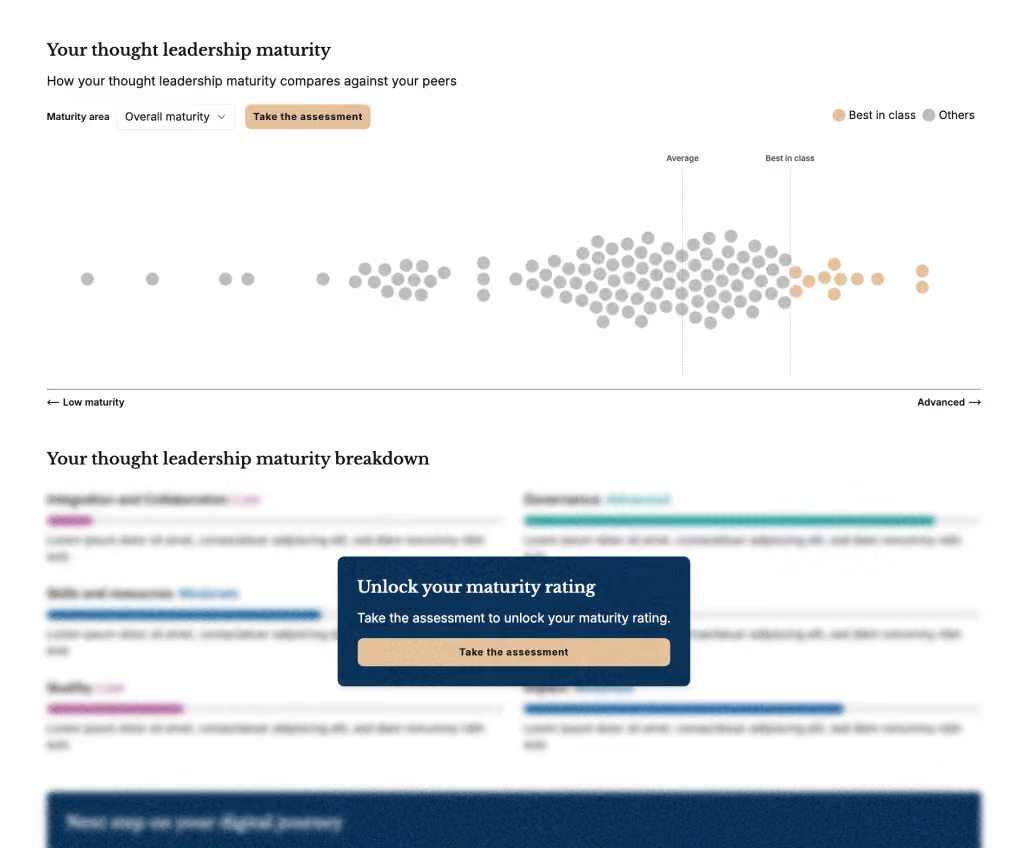
Surprisingly, relatively few B2B thought leadership campaigns feature interactive or dynamic elements. This represents an untapped opportunity. Interactive tools and data visualisations, such as self-assessments, quizzes, benchmarks, data dashboards or similar, all help to turn passive readers into more active participants. And rather than serving up static conclusions, more interactive formats can also allow executives to query the underlying data through the lens of their own company, sector, or geography.
Providing a range of content formats also helps; everyone has different preferences for how they consume content. Video and/or audio content and smart data visualisation all help to replace dense blocks of text with more engaging insights.
The most successful modern campaigns do not treat derivative assets (such as infographics, podcasts, or social carousels) as an afterthought. Instead, they design a multi-format ecosystem from day one. Shifting from static assets to more dynamic, interactive, and modular experiences, B2B brands can better differentiate themselves, while also improving their impact on AI search.
4. Rethink thought leadership workflows
Most thought leadership workflows are designed as a sequential, waterflow process. One step follows another and the project cannot move along until the previous step is completed. Stakeholder reviews are a good example of this. A senior leader may be needed for initial input to help shape the direction of a campaign. What if they are travelling, working on a demanding client project or not available? The request for a call can sit in their inbox for weeks, stalling the project and preventing further progress.
The typical approach to securing this input is to book in a 60-minute call. But what if this approach could be rethought, with the executive able to provide short voice notes or WhatsApp messages in spare minutes that can be collected, aggregated and analysed in a much more efficient way? This removes the bottleneck while still accessing the necessary insight.
Rather than seeing AI as a bolt-on cosmetic tool to enhance existing processes, a more fundamental approach means rethinking workflows from the ground up, building multi-agent systems that can process steps concurrently rather than relying on a lengthy linear process. Consider, for example, the content development stages. This typically relies on a core asset that is developed first (usually a long-form report) with various spin-off content assets such as videos, articles and presentation decks being produced afterwards. Often, a last-minute change to copy on one asset means reworking the others, too - a tedious, lengthy, manual sequence. Instead of this linear process, an asset builder agent enables parallel production. It acts as an orchestrator, loading LLMs with raw manuscripts and brand design guidelines to automatically generate a variety of web native publications. Last-minute changes can be updated on the core manuscript, and flow through automatically to every content asset.
5. Make your thought leadership commercially relevant
Companies can no longer afford the luxury of running thought leadership programmes that do not have demonstrable financial returns. “Thought leadership has to do everything it used to do in terms of building brand, but it also needs to deliver revenue,” says Áine Bryn, Chief Marketing Officer of Marsh UK. “I need to show how it enhances client retention, generates new business or expands a sale. There is now an expectation that we don’t just produce thoughts. There has to be a financial return.”
This means moving beyond marketing metrics, such as downloads, MQLs and dwell time to something that CFOs will value: pipeline and revenues. “There’s often too much of an MQL mindset with an emphasis on gated content and leads,” says Joel Harrison. “There needs to be tangible, quantifiable results from any marketing activity, including thought leadership.”
Contribution to revenues can be challenging, however, in sectors where sales cycles may extend to years rather than months. Proxies are sometimes needed alongside hard revenue metrics, which means that a balance is needed to prevent a slide towards short-termism and an over emphasis on converting, rather than creating, demand. “We need proxies that might not be hard dollars, but that directionally show that new value has been created,” says Brian Macreadie, Head of Marketing at Addleshaw Goddard. “This reflects a long-term focus and an understanding that things don’t sell overnight. “Meaningful conversations might not convert immediately but people understand that they influence future pipeline.”