

AI-powered thought leadership research is starting to reach the mainstream
Back in early 2025, there were thought leadership reports aplenty on the topic of AI, but nearly none actually featured AI within the research approach. Instead, the vast majority of studies published at that time were based on a survey, sometimes with the addition of some secondary data.
There have been a few notable exceptions since then, such as the Guinndex and its AI-based calling agent, as well as some others trying out some novel research methods. These were stand-out examples, but they were essentially outliers: the majority of studies remained survey-based.
While this norm has not yet definitively shifted, it does seem to be the case that the tide is turning. An updated review of recent thought leadership publications reveals a much wider range of data inputs, including novel uses of AI to help analyse the data.
Prompt research
The most common approach is the use of large language models (LLMs) as classifiers: reading or labelling large volumes of text or behavioural data that would be impractical for human researchers to work through. A range of recently published studies highlighted different things that can be done with this kind of approach:
- The Swiss Re Institute and the LSE used an LLM to read the 10-K filings of 91 Fortune 100 companies and mapped the causal links each company draws between its own risks. The result is a risk network that can be compared between 2019 and 2026. AI classified each risk disclosure into a distinct category and then identified causal links to other risk categories (as mentioned in companies’ risk disclosures themselves). While the report is somewhat academic in nature, the approach is refreshing and could be more widely applied in other topics. Incidentally, the risk that grew the most over that time period? AI and new technology risk.
- Revelio Labs' AI Labor Market Tracker draws on people’s profiles, job postings, reviews and layoff notices to provide a monthly update. Its methodology is somewhat complex, but an AI-based classifier flags firms as AI adopters based on their hiring, and an LLM scores various types of work activities for AI exposure, with those scores checked against separate academic measures. Put differently, it aims to infer adoption from what firms actually do, rather than what they say in a survey. This approach would benefit from a bit more simplicity, and clearer findings, but it’s interesting nonetheless - and it’ll no doubt evolve over time as it gets more established.
- GitHub's Octoverse 2026 is based on analysis of the company’s in-house data over the past year. It’s particularly interesting for its developer audience, given how central GitHub is to much of the AI-based code creation work going on. Some of its headlines highlight how rapidly things are changing: for example, developers pushed more code changes to Github over the past year than they did in the prior two years combined, highlighting the astonishing growth in code creation now underway. In this study, AI does three main jobs: an LLM assesses contributor locations (reweighted against IP data), an AI model sorts public repositories into industry sectors, and a set of forecasting models aim to predict developer numbers out to 2031. There’s plenty more going on beyond this, but a key point is that the sheer volume of data being analysed requires an AI-led approach in order to be feasible.
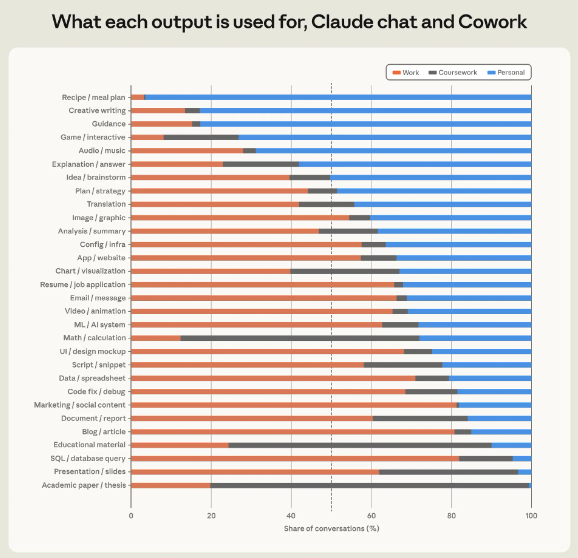
- Anthropic's Economic Index opens the window on when, where and what people are using Claude for, based on a sample of conversations with its Claude models (see example chart below). These conversations are labelled by AI classifiers, and maps them to occupations and wage data. To its credit, Anthropic shares a lot of detail on its methodology here (including specific prompts used, which would be of interest for anyone working in the field). The company also links around 9,700 survey respondents to their own usage, so stated views sit alongside observed behaviour for the same people. It’s very readable, and does a good job of highlighting the broad sweep of work now being performed within Claude today.
- Finally, while the methodology doesn’t explain how the analysis was done, inferring skills from job titles across a billion profiles is almost certainly done with machine learning or an LLM. This is from LinkedIn’s Green Skills Report, now the sixth edition of this study, which shows that employer demand for green talent continues to grow faster than workforce supply.
Not AI, but novel nonetheless
Not every example relies on AI. Three other recent reports stand out by turning interesting in-house data into a strong set of insights. While AI wasn’t necessarily used within these studies, they’re nonetheless great examples of companies making use of non-survey data to deliver fresh insights (and AI could no doubt help enhance these in future):
- The Allianz Center for Technology (AZT) published Swipe. Tap. Crash., an impactful new report highlighting the degree to which digital distraction is leading to increased dangers when driving. It uses data from over 34,000 crashes, in car eye-tracking, and other inputs to estimate that distraction may contribute to one in three road crashes today.
- JPMorganChase Institute used de-identified transaction data from more than 20 million customers, covering 2015 to 2026, to track how often households are drawing on investment wealth to fund their spending. It's a behavioural measure that a survey would struggle to capture reliably, and the resulting insights are accordingly strong.
- Consultancy HKA's CRUX Insight report, now in its ninth year, draws on the firm's own claims and dispute investigations across 2,410 projects in 122 countries. It is an excellent example for any professional services firm sitting on years of engagement data: casework can become a long-running proprietary dataset in its own right. There is clearly a significant amount of work behind what’s being published, but it is an excellent resource for its target audience.
Still room for surveys
It would be wrong to suggest the survey is on its way out. Another recent report from the past month, AXA's Future Risks Report, is now in its 13th edition, polls 4,345 experts in 62 countries alongside 24,000 members of the public in 19 countries. Its value comes from scale, consistency over time, and the ability to compare expert and public views. (Fittingly, AI has now overtaken climate change as the experts' top-ranked risk.)
More generally, surveys remain the norm for most corporate thought leadership research today. For many use cases, it remains the most practical choice, especially for topics where little or no relevant data exists. But it is intriguing to finally start to see a more meaningful batch of studies coming to market that are using AI in new ways.
Taking your own first steps
For thought leadership teams considering these methods, the examples shared above suggest three main pointers:
- Start with the data you already hold. Transaction records, platform usage and casework are often more distinctive than anything a survey can produce, and are by definition proprietary for your brand.
- Use AI to read what humans can't. Filings, job postings, reviews and transcripts are rich sources that were previously too large to analyse in full with a human team. In particular, the ability to sensibly classify and assess large volumes of data is a powerful method for firms.
- Validate, and say how. The more credible studies check their AI-generated outputs against a benchmark and document the process. That transparency is also what makes the findings defensible with journalists and sceptical readers.
Two years ago, AI-based research in thought leadership was nowhere to be seen. Today, it remains a minority approach, but it's a growing one, and the range of methods is widening from month to month.